

Around this time every year, people around the Northern Hemisphere remember what a wonderful invention the swimming pool is. Although they are expensive to maintain, modern advances in motor and pump control have decreased costs by cutting energy use. However, this increase in efficiency comes with an increased risk of motor bearing failure.
Pumping More for Less with Variable Frequency Drives
For unheated swimming pools, commercial, municipal, or residential, the electricity used to circulate and filter the water is the single greatest cost of ownership. The pumps and motors driving this filtration must be oversized. This allows them to continue moving water at acceptable speeds even when the filter becomes partially clogged. Because of the pump affinity laws, it also means that they use more energy than needed when the filter is less clogged. For example, if the flow rate is doubled, the power consumed increases by a factor of eight.
Variable frequency drives (VFDs) address this problem by controlling the speed the pump system runs at. Larger pumps can be run at the lowest speed necessary. VFDs are usually used for larger pools, using three-phase current. But the residential pool market is also seeing more use of VFDs with special transformers to convert household one-phase current to three-phase.
Whatever the size of the pool or pumping system, there is a tradeoff: VFDs can also cause electrical bearing damage to the motors and pumps that they control.
Electrical Bearing Damage from VFDs.jpg?width=300&height=376&name=pitting-frosting-fluting%20(2).jpg)
VFDs control motor speed with a technique called pulse width modulation (PWM). The problem with PWM is that its output is not balanced. VFDs' unbalanced output creates a voltage on the shaft of the motor that it controls, and that voltage tends to discharge by arcing through the motor bearings. This arcing damages the bearings by roughening them, leading to increased vibration, noise, friction, and heat, and often premature failure.
Simply insulating the motor bearings is not a solution, because the voltage will still be present on the shaft and will tend to discharge through the pump bearings and damage them instead.
If the shaft voltage from VFD use is not mitigated, premature bearing failure can wipe out the savings from reduced energy use.
A Solution to Shaft Voltage Discharge Damage
AEGIS® Shaft Grounding Rings mitigate the risk of premature bearing failure in pool pump systems by giving shaft voltage a safe, nondestructive path to ground. In a motor with an AEGIS ring installed, shaft voltage does not build up until it arcs through a bearing; instead, it is dissipated through the ring to the motor frame.
AEGIS rings thus allow VFDs to sustainably deliver energy savings, without causing damage or premature failure to the pumping system and incurring repair or replacement costs.
A Case (Study) in Point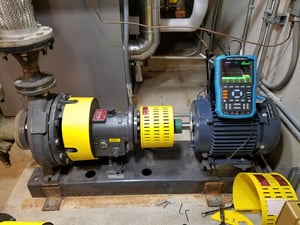
Ten years ago, a large midwestern US recreational center had several of their pump motor bearings fail prematurely. They knew something had to be done, so they came to us and got a second opinion from the vendors of a competing technology. Not to spoil the surprise, but AEGIS rings reduced the motors' shaft voltage to safe levels, and the other product did not.
To learn more, see our Pumping Systems application sheet.
Summary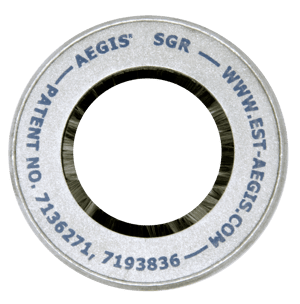
Swimming pools have always been expensive to operate, but variable frequency drives significantly cut the amount of electricity it takes. VFDs can, however, cause electrical bearing damage that can cause premature bearing failure and requires expensive repair or replacement (not to mention leaving would-be swimmers out in the heat until the pumping system is fixed).
AEGIS Shaft Grounding Rings dissipate the motor shaft voltage that VFDs create, protecting the bearings from discharge damage, protecting pool owners from repair costs, and keeping pool users cool and happy.
To learn more about AEGIS shaft grounding and best practices for electrical bearing protection, sign up for a training. We offer monthly live training webinars, and we can also visit your facility to review your exact application.
